Lesson 4: India: Unity within diversity
A . Read the following text and answer the questions.
India is our closet neighbour. It is the largest among South Asian Countries. In fact, India is the seventh largest country in the world with an area of 3,287,590 square kilometres. India is bounded by the Indian Ocean on the South, the Arabian Sea on the West and the Bay of Bengal on the East. It is bordered by Pakistan to the West; China, Nepal, and Bhutan to the North; and Bangladesh and Myanmar to the East. India is the world's second most populous country after China. Its current population as in 2010 is around 1.15 billion.
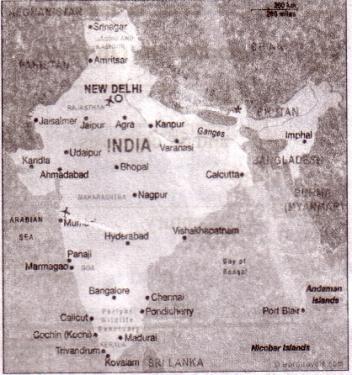
New Delhi is the capital of India and about 13 million people live in the capital. India is a land of ancient civilization. The social, economic, and cultural configurations of this vast country are the products of a long process of region expansion. Indian history begins with the birth of the Indus Valley Civilization and the coming of the Aryans. During this period, Aryan culture flourished in this part of the world. The fifth century saw the unification of India under Ashoka, and it is in his time that Buddhism spread in many parts of Asia. In the eighth century, Islam came to India for the first time and by the eleventh century it had firmly established itself. I resulted into the formation of the Delhi Sultanate in 1206 by Qutb ud din Aybek. This was finally succeeded by the Mughal Empire in 1526, under which India once again achieved a large measure of political unity.
It was in the 17th century that the Europeans came to India. This coincided with the disintegration of the Mughal Empire, paving the way for supremacy among the English, the French, the Dutch and the Portuguese. The English emerged as the 'victors'. In 1774 Warren Hastings was appointed the first Governor General of India by the East India Company.
77In 1876 Queen Victoria was given the title Empress of India by the British parliament and India came under the British rule completely. They ruled India for nearly two hundred years. This period was marked by India's struggle for independence. Through a series of heroic and patriotic movements to restore freedom, India got its independence in 1947.
The culture of India is one of the oldest and unique in the world. In India, there is amazing cultural diversity throughout the country. The South, North, and Northeast have their own distinct cultures and almost every state has carved out its own cultural distinction. There is hardly any culture in the world that is as varied and unique as India. There are 17 major languages and 844 dialects used by the people of India.
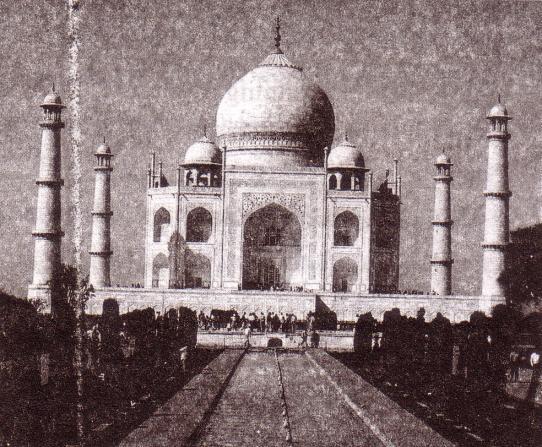
India is a tourists' delight. The Taj ahal, FatehPur Sikri, the Qutab Minar and the Red Fort are a few of the many wonders which attract people from all over the world. Kashmir has been described as a paradise on earth. The country of mountains, valleys, deserts, rivers
and lakes offer the richness of a mini world within a single country. Ooty, Nilgiris and the temples of South India. Ajanta and Ellora caves are the places one can explore in
India.
B Discuss the following questions in pairs.
1 What do you know about the population and size of India?
2 When did Buddhism spread in India?
3 What happened to India during the Mughal Empire?
4 What are some of the tourist attractions in India?
|
Indus Valley Civilization and the coming of the Aryans. |
|
15th Century: the [dash] of India under Ashoka and spread of Buddhism. |
|
8th century: [dash] came to India for the first time |
|
1206: Establishment of the Delhi Sultanate by [dash] |
|
1526: Beginning of the [dash] Dynasty |
|
1774: Warren Hastings was [dash] the first Governor General of India by the East India Company |
|
In 1876 Queen Victoria was given the title Empress of India by the British [dash] |
|
1947: India achieved its [dash] |
C . Complete the flow chart below to show the history of India. Use one word to fill in the each gap.
|
Indus Valley Civilization and the coming of the Aryans. |
|
------> |
| 15th Century: the [dash] of the India under Ashoka and spread of Buddhism. |
|
-------> |
| 8th century: [dash] came to India for the first time. |
|
--------> |
| 1206: Establishment of the Delhi Sultanate by [dash]. |
|
--------> |
| 1526: Beginning of the [dash] Dynasty. |
|
------> |
| 1774: Warren Hastings was [dash] the first Governor General of India by the East India Company. |
|
-------> |
|
In 1876 Queen Victoria was given the title Empress of India by the British [dash]. |
|
--------> |
| 1947: India achieved its [dash]. |